Bolanle Idowu
An excerpt from “Homeunbound: Stories of Migration, Identity and Belonging”
“When I return to my country, I realise how good it is to move around. When you stay just in one place, you are not exposed, you are not learning and relearning what you already know.
Sometimes we do need to relearn. I don’t want my brain to be dormant. I like to know a little bit of everything, and if the whole world had this mindset, it would be a different place.
If people all stay with their thoughts and beliefs, while the world around them moves so fast, they‘ll be left behind.”
Nígbà tí mo pa dà sí orílẹ̀-èdè mi, mo mọ̀ pé ó dára láti máa rìn káàkiri lò si orilè-èdè imiran.
Nitoripe nigba ti eniyan ba duro ni aaye tabi oju kan, iwọ ko ṣe afihan, iwọ ko kọ ẹkọ, ati tun kọ ẹkọ ohun ti o ti mọ tẹlẹ.
Nigba miiran a nilo lati tun kọ èkọ titun. Nko fe ki òpòlò mi daduro. Mo fẹ lati mọ diẹ ninu ohun gbogbo, ati pe ti gbogbo agbaye ba ni ero yii, ile aye yi yio jẹ aaye ti o yatọ.
Nitoripe nigbati gbogbo eniyan ba duro pẹlu awọn ero ati igbagbọ wọn, lakoko ti agbaye ti o wa ni ayika wọn nlọ si iwaju ni iyara ati kià kià, wọn yi o fi iru awòn eniyan bè silẹ sèyin.
GROWING UP IN NIGERIA
Over six years ago, I left my job in Lagos to study for a Master’s Degree at the University of Twente. I wanted to study and explore a new culture, and I thought the Netherlands would be a good place for it.
Growing up in Nigeria I went to boarding school, which was for the middle class and affluent, not very popular. My parents were both busy business people and probably felt they didn’t have enough time, so not wanting to just leave us home alone, they opted for boarding school. I didn’t like it at the beginning, because every time I returned home I felt isolated from my neighbourhood friends who all attended public school. But I learned to appreciate the opportunity later on.
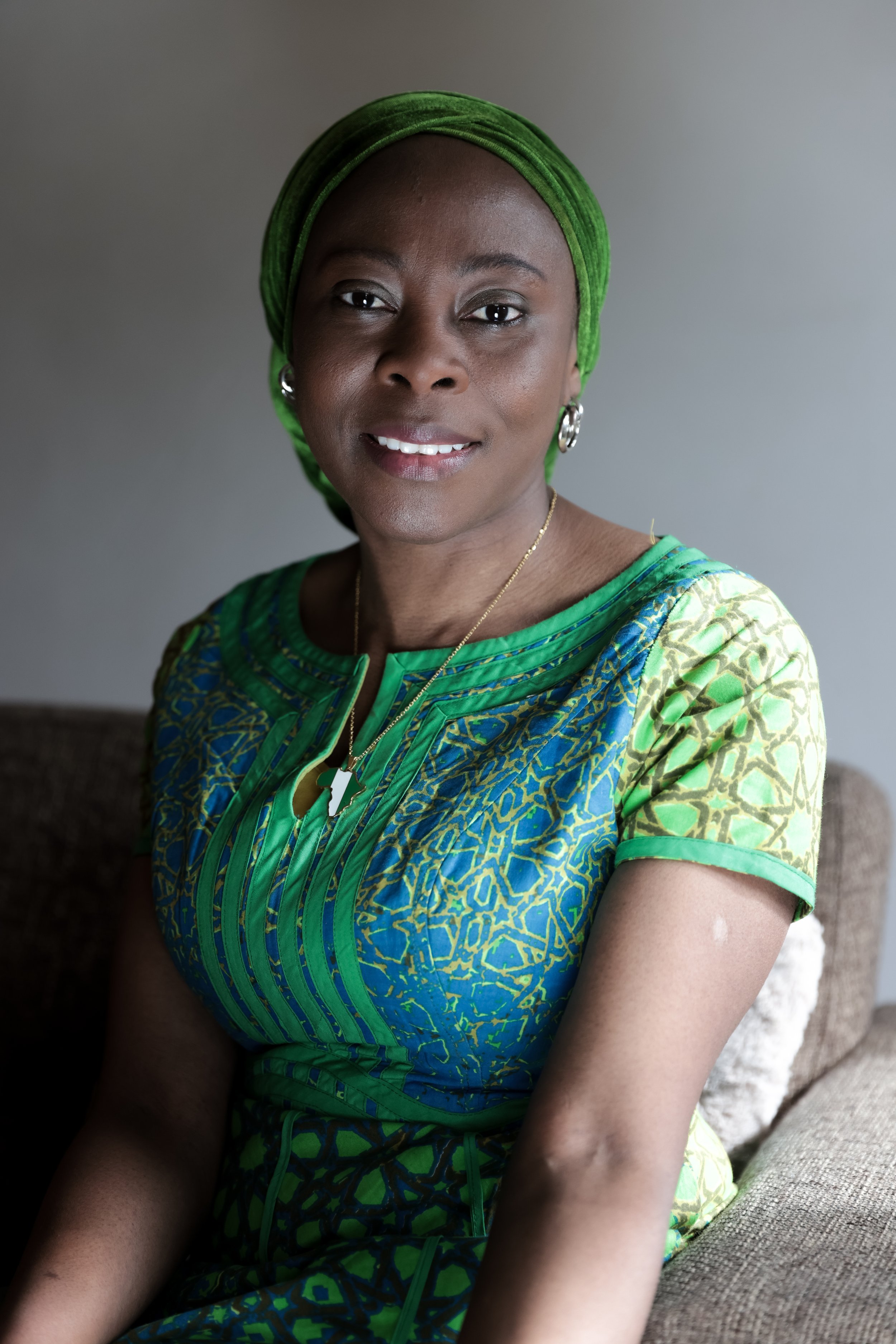
Photos by Annabel Jeuring
Since my father, as a muslim, had more than one wife, we had a large family. I grew up happily. I was a privileged child: I had all I needed and didn’t have to struggle for anything. Nonetheless, my parents taught me to not take anything for granted, and I never did. Now as a mother, I am trying to teach my kids the same, hoping that they make good use of it. When you have access to things, you should remember that some people don’t have it as good, not because they don’t want to, but because different people experience life differently.
LET ME TELL YOU ABOUT MY COUNTRY
Back then in Nigeria, goods were very cheap, there were enough jobs for people and our population wasn’t as big as it is now. We had communities, our society is structured like that. If coming out of your house you saw children doing something they shouldn’t be doing, you could reprimand them and they would listen to you. Even though now people are changing, we still have that shared sense of responsibility. The whole community raises your children, keeps an eye on their wellbeing and informs you when they feel there is something wrong going on.
This was about twenty or thirty years ago, but in the ‘90s things started to change. The population exploded and the government hadn’t planned accordingly. There was more money in circulation, the middle class expanded and the population growth got out of control. As a child, I remember watching TV programs encouraging you to not have more than a certain number of children, so there was a sort of policy in place. They would inform people and offer free child control consultations and contraception at the hospital. The government would cover the expenses.
But now with the exponential population growth, they don’t even know how many we are. I did a dissertation on this topic, and while at the moment the population is estimated at about 206 millions, we know many have not registered so there are a lot of children that are invisible to the government. Parents wait until they are five years old to register them, when it’s time to start school, but until then you don’t know they exist.
This makes it impossible for the government to plan ahead properly. They provide infrastructure for the amount they know, and then suddenly there are many more that have to share that same infrastructure. For example, schools are built with a certain number of children in mind. If a class meant to have twenty students ends up having forty instead, classes are overcrowded, teachers are overburdened, and the students struggle.
For this reason, middle class families don’t want to send their kids to government schools anymore, but rather to private ones. We currently have many private schools, which are good but sometimes very expensive. The public schools used to be good enough, that’s where everybody used to send their kids before. But now the private schools attract the best teachers, impoverishing the quality of education in the public schools.
WHAT I AM PASSIONATE ABOUT IS…
From a practical point of view, it wasn’t difficult leaving Nigeria because I had the resources. What was hard was giving up my job, which I liked and paid very well. I had been at that company for sixteen years, contributing to making it into what it is today. I worked in different areas of the organisation: I started in sales, then moved to customer service, marketing, business intelligence, research and franchise operation. In the last part of my journey there, I worked in customer service, attending to high profile customers which I treated as my guests, how I would like to be treated. Whenever I meet someone, I make sure to make a positive impact on their lives. I loved this aspect of my job, and I do miss it.
But I had to move on, and I was also passionate about what I was coming here to do. I wanted to study something related to policy analysis and public administration. I am interested in how the government operates, in its strategies and how they are implemented. Personally, I always wanted to do something to influence my society, no matter in how small of a way. I felt that coming to Enschede for this Master in Public Administration would boost my previous knowledge in Service Management. I imagine a government that while making policies, reflects on how they impact people’s lives and where people are treated as loyal customers. If that were the case, many wouldn’t migrate. They would stay in their country, or if they leave, they would come back to impact their societies positively.
You will find Nigerians in every country of the world, and most of them are talented people. I feel that all that talent should stay in the country and be used to develop it further. When I came here, I did it thinking it would enable me to make an impact on Nigerian society, where no one is paying attention, where nobody is monitoring, where they just make policies and move on to the next thing.
THE INITIAL SEPARATION
As a family, we decided that my spouse wouldn’t follow me to the Netherlands and initially the children weren’t supposed to either. We are very close, my children and I. When I was away, I would spend a lot of time on the phone doing homework with them. I had their school calendar memorised and was constantly reminding them of events and things to do. Eventually it became too much for me, managing my studies here and my family in Nigeria. So, I decided it would be better to bring the kids over.
WHAT I MISS
I would have liked to bring the food culture here. In Nigeria, food is very cheap and fresh food is always available. If I wanted to buy chicken now, I could get a live one from the farm. If I wanted to get some fish, there are places where the fish are alive and you can pick the one you want. I also miss the support that you get when you raise your kids. If I was late picking up my child or if something unexpected happened, I could easily ask a neighbour and it would be fine. You know all your neighbours. Since being here, I don’t think I’ve met any of my neighbours except for the one next door. They are really old and I took it upon myself to check on them. When we don’t see them in their backyard for some time, we knock on their door to make sure they are okay. That’s how it’s done in Nigeria. People knock on your door to ask if everything is alright, or if they are going to the market, they come and ask if you need anything. I miss these things. Here, everyone is on their own.
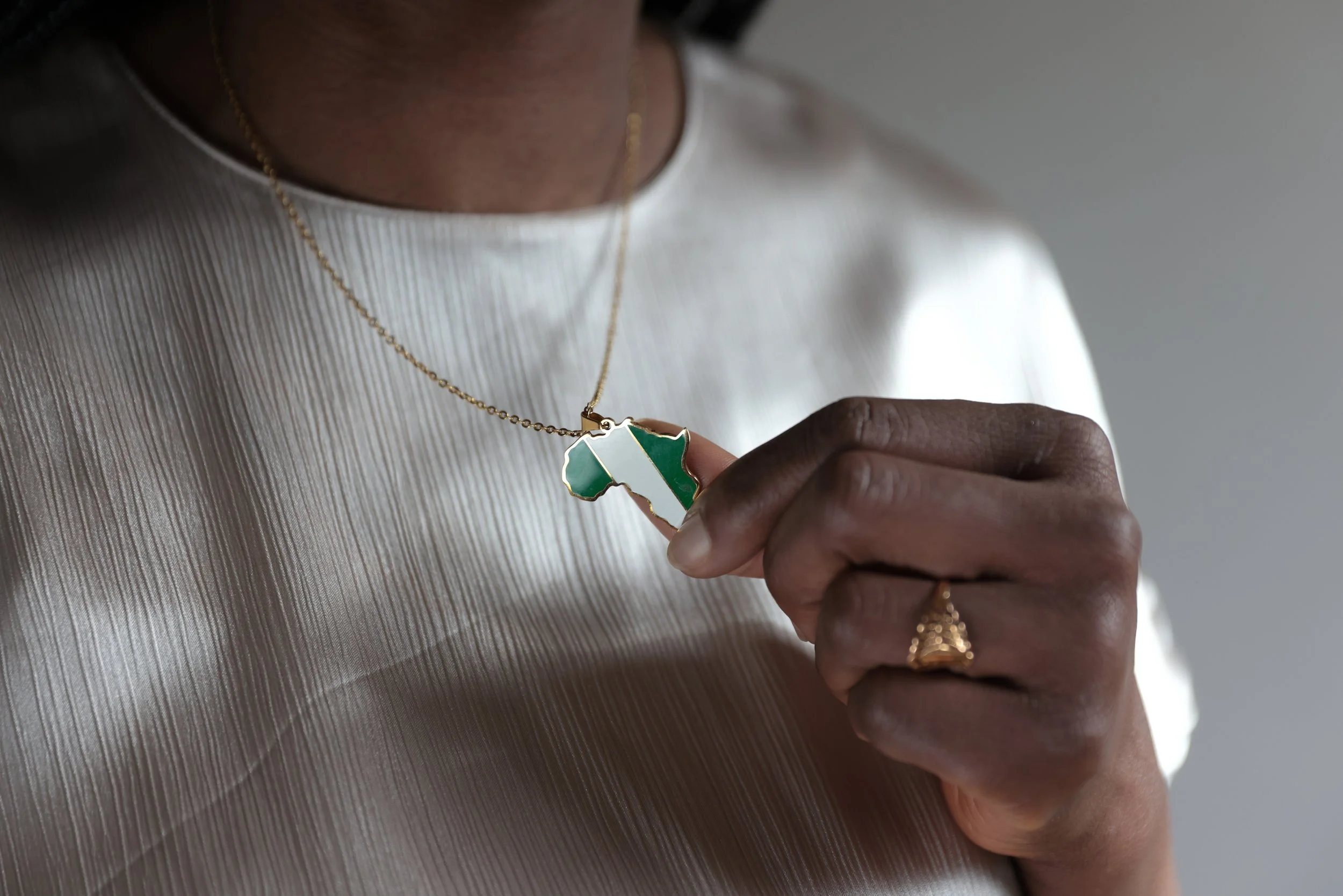
With all of the challenges we have in my country, we do know how to party. Every weekend there is a gathering with lots of food, where you meet family, friends, people you haven’t seen in a long time and you laugh a lot. My immediate family is large, so large that I don’t even think Iknow all of my cousins on the maternal side. What I like about it is that whenever there is an event for one of them, maybe a birthday, we all try to show up. We’re very supportive of each other and always find time for family.
I HAD MANY STRUGGLES SETTLING IN
Finding a place to live after my contract expired was my first challenge. I had to bring my youngest son over and I still hadn’t found accommodation. I never want to do to others what I wouldn’t want to be done to me, so even though it was a difficult time, I didn’t ask for an extension and decided to solve it on my own. Luckily, just one day before I was due to move out, when I was packing my things, I met a student who said they had an extra room. So my son and I spent one month there, until we found another place. This is one of the things I struggled with, it was really tough.
Language will always be a problem for me. Although I am learning Dutch, it’s a slow process. This might be because in the university environment where I am, everyone speaks English. Fortunately, I was able to find schools for the kids, but naturally it was an added responsibility as a full time student myself. It was very challenging. Sometimes I had to leave my class to pick up my youngest son from school, and then go back to class again. I have had situations where I had him sit outside of my class while I was finishing my lecture. Some time later, through the Nigerian students association, I found someone very nice who would pick him up, feed him and take good care of him until I got back home. It was like having the Nigerian community culture back, and I was very grateful for that. Sometimes, when I get to bed at night, I just thank God that I have survived that day. I don’t think of the next day, because if I do I might get depressed or sleepless. Sometimes, I can become overwhelmed, as I have also had health problems. I have been slowed down by those too.
DIRECTNESS OR RUDENESS?
Something I have struggled with here is the level of service, I have found it to sometimes be disappointing. For example, at one of my medical appointments, I asked if I could communicate in English. The receptionist said her English wasn’t very good but she offered to call a colleague that could speak it very well. I got excited and agreed, but when the colleague arrived, she looked at me and started speaking Dutch. She said, point blank, that she didn’t want to speak English. I was shocked. I know Dutch people can be a bit direct, but sometimes I feel we need to be diplomatic about certain things. I asked her why, and her answer was that she ‘didn’t feel like it’.
My level of tolerance is really high, but I don’t take nonsense from people. If I see something bad happening to other people, I stand up for them, I don’t care. If I can make a difference and bring something positive, I am always open to it. So when she said that, I replied that she should not have come at all, that she had betrayed the trust of the colleague who had asked her over, and that she was being racist. The time it took her to speak to me in Dutch is the same amount of time it would have taken her to speak in English. I told her that although I couldn’t force her, she could have chosen to be compassionate, not knowing what I was going through and what the reasons for me seeking help were. This would not have happened in Nigeria. People that come to your medical establishment are like customers, you wouldn’t treat them like that. You don’t have to be pleasant if you don’t want to be, but this is the basics, I was only asking a question.
As for me, I will always try to teach you if you don’t know. Maybe nothing can be done in the moment when something bad is happening, but speaking up could make the other person stop and think. They could maybe do something differently. But if you keep it to yourself, you’ll never know if there is the possibility of change.
THE UNIVERSITY COMMUNITY
On the flip side, the university community has made me feel very welcome, and the fact that they put a roof over my head was such a great relief. The university takes care of all the basic things, registration, bank account, which I would have struggled with if I had to do them by myself. Thanks to the orientation week, I was able to make friends and meet many more over time. These things helped me to get over the initial hurdles.
THE NETHERLANDS IS A BEAUTIFUL PLACE, ESPECIALLY ENSCHEDE
When I first came here, my intention was to complete my study and then go back home. But now, my kids don’t want to go back. This is the challenge I am facing right now. The Netherlands is a beautiful place, especially Enschede. It is very safe, which is a priority, especially for the children. Most of the things I have done in my life are because of my children. I wouldn’t have left my career, a very good job, to come and sit here otherwise. I left to get this degree and boost my career options, but now the kids like this place. So what should I do? Abandon my career to allow the children to stay here? Because that’s what it looks like right now. I can’t get the kind of job I’d like here, and I’m not sure I’ll be able to get the jobs I am qualified for if I stay. I have sixteen years of experience, three masters degrees (I did one in Nigeria, one in the UK and now this one). These are some of the challenges I might face. I always try to be optimistic no matter how bad things are. Sometimes there are things that you don’t have control over, and in these cases, why work yourself up? I just hope and try to stay positive about it.
COOKING MAKES ME HAPPY
Something I have not yet fully learned about Dutch culture is the food. Bread and sweets are big here, but I am trying to reduce those as much as I can because I want to eat healthier. I experiment a lot with food and don’t want to just stick to my own culture, I want to explore other cultures also in their culinary aspects.
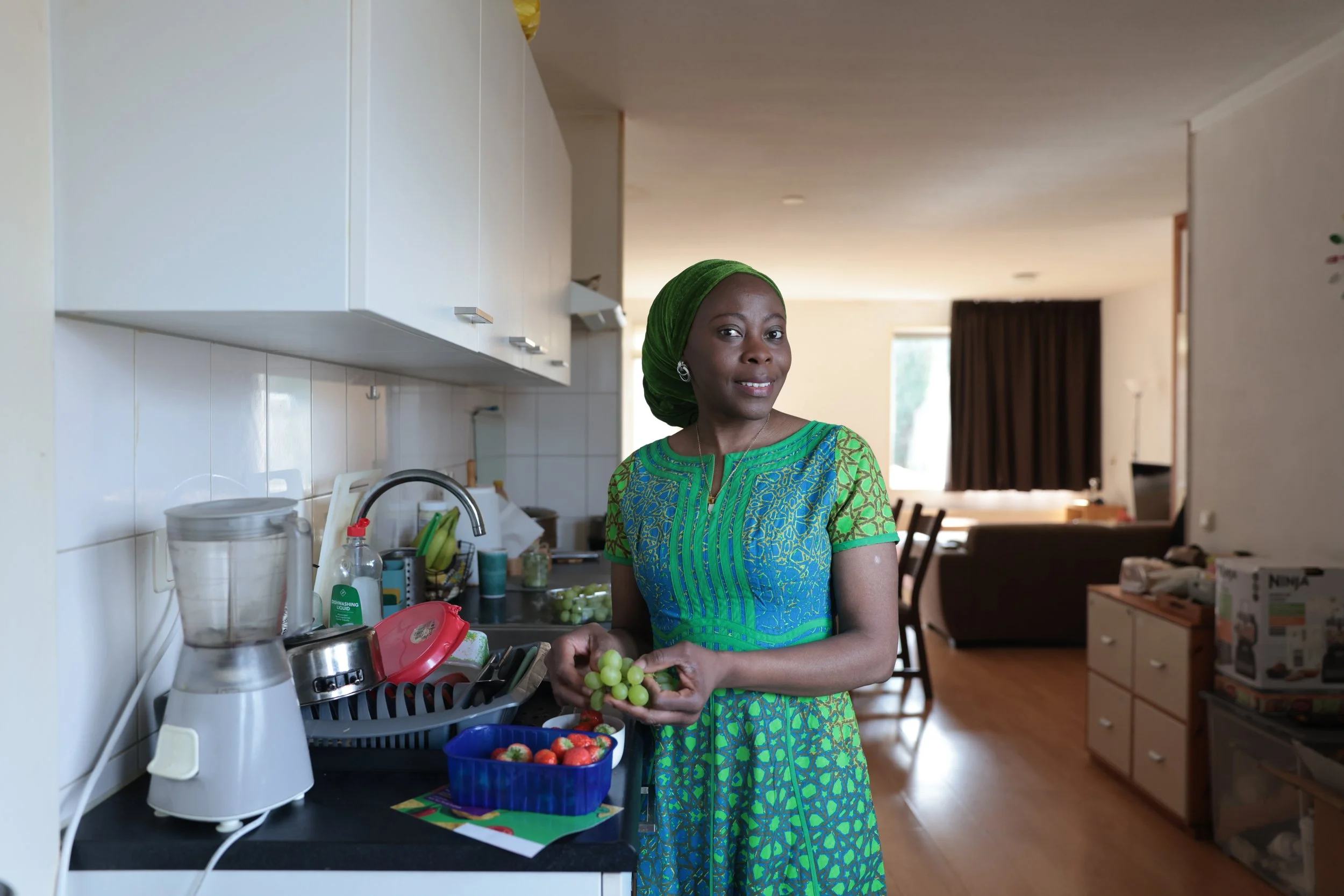
Cooking makes me happy. I spend hours in the kitchen. And in fact my favourite word in my language is ounje, which means food. That’s the word I have in my head all the time. If I go for a walk and see a plant, I immediately start thinking about what I could combine it with. I am always thinking about recipes. One day I actually spent nine hours in the kitchen, I couldn’t believe it. I did a few other things in between, but when I checked the time, I saw that it had been nine hours, from the morning until the evening. Normally, I just prepare food for the week, but that day I decided to make soup, and then cake, and then some snacks. My little one asked if we were going to have a party. Maybe one day I’ll organise cooking lessons. There is an event in Enschede where people cook food of different nationalities, and I hope that someday I might have time to contribute.
YORUBA SUNDAYS
I love studying Dutch. Maybe it’s because I am very inquisitive when it comes to learning. So when I find a word that is interesting, it triggers something else and I spend a lot of time on it. While English is the official language of Nigeria, used in business and schools, we also have three main languages spoken in different parts of the country: Yoruba, Hausa and Igbo. We dedicate Sundays to speaking our language at home. I encourage my kids to speak Yoruba more, especially now that we are here, because if they don’t, they will lose it. The time I feel I’m at home is when I am together with my children: we cook, we talk and we watch movies. That’s what we used to do back in Nigeria. When I sit here, with them, I remember how it used to be.
STAYING CONNECTED TO MY RELIGION
Staying connected to my religion requires more effort and self-dedication here, because there is nothing external supporting me, like the ‘call to prayer’, and being surrounded by other muslims belonging to my culture. In Nigeria, it’s very easy to practise your religion: whether you are muslim or christian, every neighbourhood has a mosque and a church. The challenge in connecting with other muslims in Enschede is that we often speak different languages. The people you meet in the mosque may have Dutch as a common language, which still is challenging for newcomers, but then they all have different mother tongues. It’s not easy, but according to Islam you can do everything inside your house, and I try to do it for my kids. I try to provide them with the support that I had growing up, and that they somehow lack now.
WEARING MY IDENTITY
Another thing that helps me stay in touch with my culture and background, regardless of where I am, is wearing Nigerian clothes. They represent my identity and my history, which I don’t want to lose. When meeting other people, it’s always useful to reflect on who you are and where you come from. It helps people to know you better and connect with you, and you help them to broaden their knowledge because when you start saying little things about you, you trigger their curiosity. One doesn’t have to go to Nigeria to learn something about Nigeria, you can learn lot just by meeting its people. Irrespective of how much you blend into your host culture, you should always keep your identity. It’s what makes us. If you throw it away, how do people know who you are?
IS MY FUTURE IN THE NETHERLANDS? IT DOESN’T DEPEND ON ME
In terms of future jobs, if I have the opportunity, I would like to do what I was doing previously, even though it was stressful. One of the things that gives me joy is looking at the people I serve, and seeing them happy once their problems are solved. I would also like to have something of my own. I already have some businesses on the side, like training people in their personal development, and selling some ladies’ accessories. If, God willing, I have the chance, I would like to make it bigger and I also wish to be involved in the policy making of my country, maybe as a consultant. I know I can contribute a lot. The social policies in Nigeria need to be monitored and evaluated, but I am not sure there is anyone currently doing that. If the policies aren’t working, they should be changed, not just left in place. There is also a lot of miscommunication of these policies to the people. If they don’t even know that they exist, how can they make good use of them? If I have a chance, these are the areas I want to influence.
But whether my future is in the Netherlands or not, doesn’t just depend on me. I have people attached to me, my children. I will continue sacrificing everything for them, like my mother did for me. Maybe my future is temporarily going to be in the Netherlands, until the children grow up, but mostly I want to dedicate my future to making a change in my country.