FROM PUGLIA TO NORTHERN SPAIN:
A LIFE IN SERVICE OF ITALIANS ABROAD
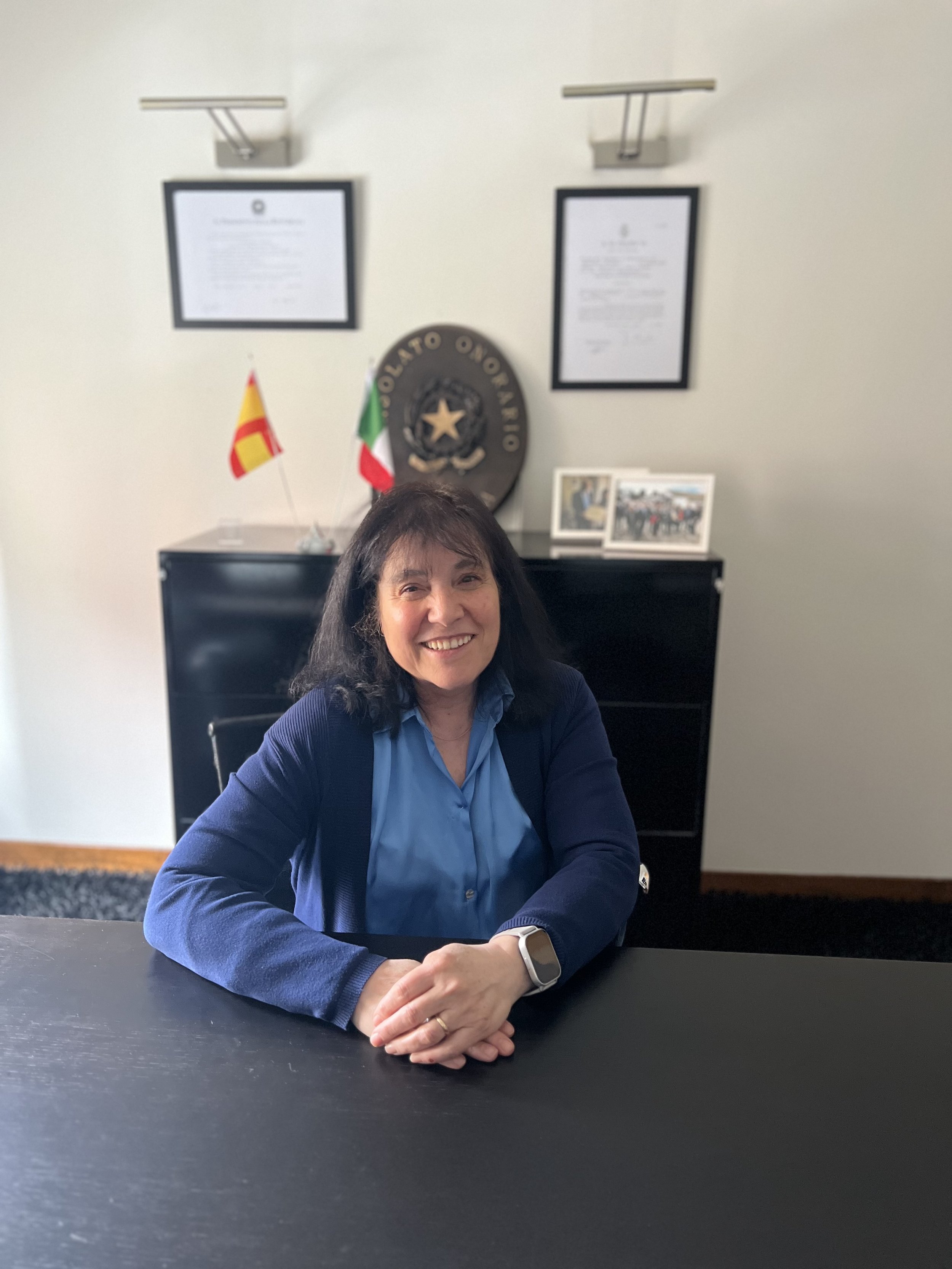
In this conversation, Honorary Consul Luciana Schiavarelli retraces a journey born out of love and transformed, over time, into a cultural and civic mission between Italy and Spain. An Italian teacher, founder of a cultural association, and institutional figure, Luciana recounts a life built on listening, voluntary commitment, and a concrete idea of community that is renewed every day.
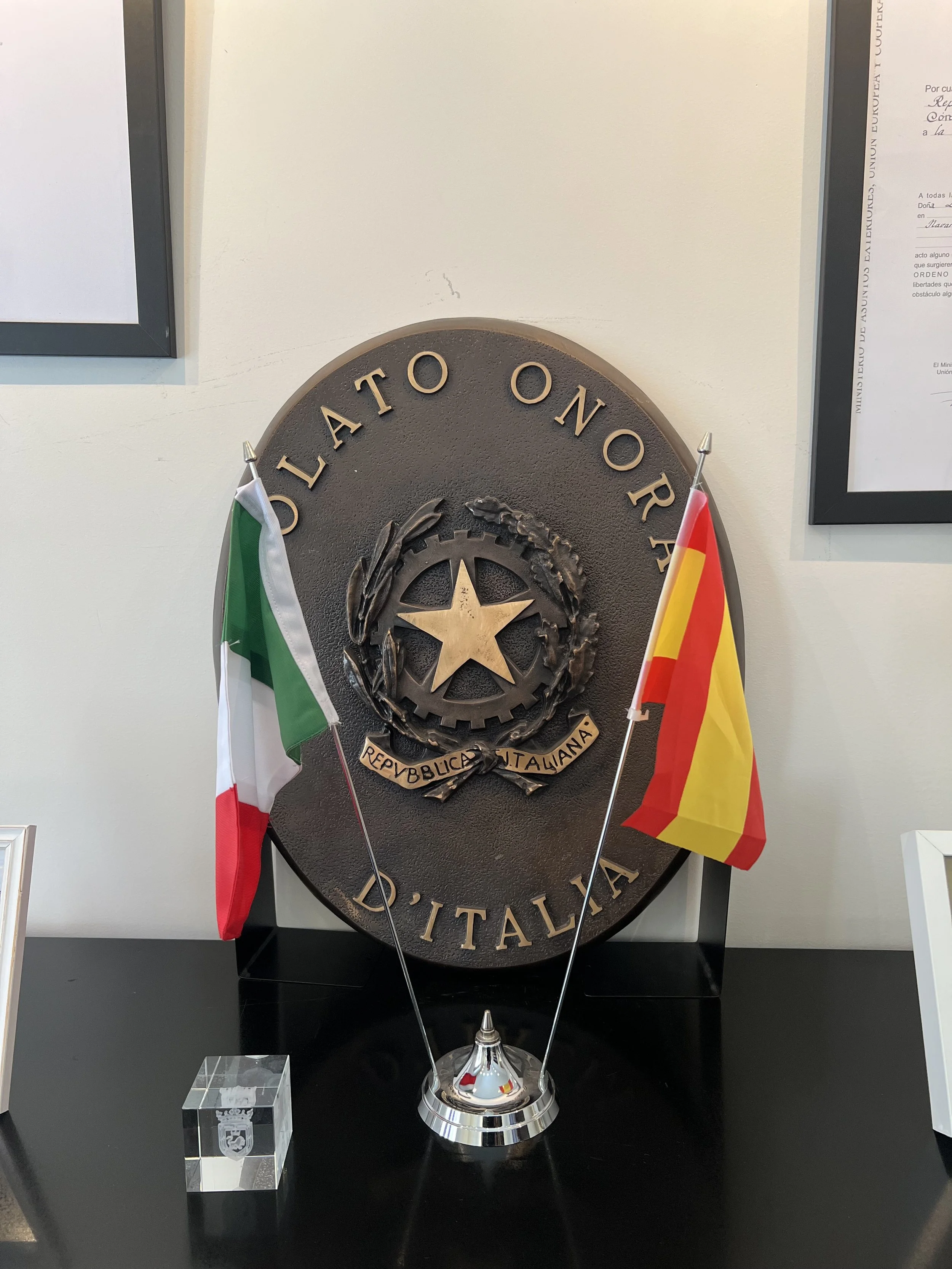
Our conversation takes place in the small office of the Italian Consulate in Pamplona, where work never seems to end: even after office hours, the phone continues to ring, as if to remind us that the needs and concerns of Italians abroad never end. Through personal memories and reflections, we spoke about emigration, identity, and a sense of belonging, but also about the struggle and beauty of living far from home.
Honorary Consul Luciana Schiavarelli, good morning. Could you tell me a little about your personal journey and what led you to live in this part of Spain for so many years?
I came to Spain in '86 for a wonderful reason: love. I met a Spaniard in Switzerland while I was working there as a student, and as soon as I finished my studies, I got married and my adventure in Spain began.
So you’ve been in Spain since 1986, nearly forty years ago…
At that time, there weren't many Italians; we were quite rare. And since the Spanish were so enthusiastic about Italy, they all wanted to tell me about their experiences in our country, where they'd been and what they'd done. I was moved by their stories, and I listened to each one as if it were the first. Since then, I've counted thousands, and I still continue to listen to new ones. And do you know why? Because it's very important to me that someone visits my country and then speaks about it with enthusiasm; it fills mewith pride, and it's the reason why, in the end, I accepted the post of Honorary Consul.
Let's just say that my love for Italy became both a passion and a mission. And even though I feel at home here, I have always undertaken activities related to Italy, promoting its culture. When an ambassador visited our region and learned about the atmosphere I'd created with the association and various exhibitions, he asked me to accept the role of Honorary Consul. I thought about it for a long time because, although not everyone knows it, it is voluntary work. We do it out of love for our country and our fellow citizens, but we don't receive any remuneration in return. But in the end I accepted, and of course, I'm proud of it.
What kind of satisfaction does this role give you?
Above all, it brings moral satisfaction, such as helping people in difficulty. Sometimes there are difficult cases to resolve, many complicated situations and I enjoy talking to people and hearing their stories; including those of the new Italians arriving from North and South America. I never forget that Italy is a country of emigrants.
If Italy was able to rebuild itself at a certain point in history, it was also thanks to the contributions Italian emigrants sent home. And this is very important. During my adolescence, I was also part of a theater company and we toured various European countries, with the support of Italian embassies who wanted to help their compatriots feel less isolated. In the 1970s and 1980s, travelling was not easy; many didn't have the opportunity to return to Italy often. I came to know emigrant communities firsthand, and whenever they welcomed us, they were deeply emotional. Sometimes they would hug us and cry. It was then that I decided that, if one day I had the opportunity to do something for Italians abroad, I would.
And you kept your word.
What advice would you give to Italians who want to move abroad, especially the many young people considering it today?
Spain welcomes people with open arms, especially Europeans, and Italians in particular, because the Spanish people truly love Italians. But my advice, before taking such a step, would be to make sure to have something solid to rely on.
What stereotypes about Italians bother you? And why do you think it's important to challenge them?
I come from Southern Italy and I'm proud of it. But often, simply saying that, leads people to associate the South with the camorra or the mafia, and that bothers me terribly. About fifteen years ago, in Spain, a chain of restaurants called La Mafia Se Sienta a La Mesa (The Mafia Sits Down at The Table) started to expand. I strongly opposed this chain precisely because of its name.
There's one here in Pamplona, and I've never gone in. I still remember the first time I walked past it and asked myself, “Why?”
Exactly. I also wrote to the Corriere della Sera, and a member of parliament took an interest in it because many Italians were offended by it. In the city where I live, perhaps also because of my criticism, the restaurant ended up closing. I explained to my Italian students why I was upset by drawing comparisons: "How would you feel if I opened a restaurant in Italy with the name "ETA sits down at the table?” And many of them realized that it wasn't something to be taken lightly.
I believe that perhaps films about the Mafia have done harm, because sometimes they romanticize what shouldn't be idealized, turning criminals into heroes. Many Italian mafiosi take refuge in southern Spain, but since there is such close institutional collaboration between the Italian and Spanish police, they're quickly caught. And that makes me happy. We often don't really see Europe, but at the level of institutional cooperation, it exists and it is visible.
In recent years, collaboration has even strengthened. During the San Fermin festival in Pamplona, Italian police officers come to assist the Spanish police in dealing with crimes involving Italians. I've had to call them many times, for example, if an Italian was robbed. I contact the police, and they put me in touch with the Italian officers, who obviously speak the language, and help them, for example, with paperwork. There's a lot of collaboration at this level. And then, on the Camino de Santiago, there are also Carabinieri along the route. They help pilgrims in difficulty, either for health reasons or for problems with documents and are available for any emergency.
How has your relationship with Italy changed over the past 40 years?
I'm happy to live abroad because, even though I know that there are things that could be improved, I love Italy and since I visit as a tourist, I only see the best parts. Every year I spend my holidays in Italy; it's my dose of home. But when I hear stories about young people or entire families coming to Spain to look for work, it pains me. Is it possible that so many people in Italy have no job opportunities?
What are the differences between Italians who emigrated thirty or forty years ago and those who do so today? Do they leave with a different frame of mind? Are they better prepared, more ambitious, or more disillusioned?
These areas are very developed, a bit like Spanish Switzerland. There is a certain well-being and it is precisely the autonomous communities that help foreigners the most when they are in difficulties. They don't leave anyone behind. I've had many cases where the governments of Navarra and La Rioja have provided assistance. I often receive calls from shelters where they've taken in an Italian who was living alone, struggling financially, or with health problems. There have been cases where they paid for Italian documents; we're talking about passports costing €116. They take care of these things because we're in Europe, but also because there is humanity and an efficient administration. And this attracts many Italians and companies because there's less bureaucracy, more efficiency, and easier access to other regions from Spain.
From a commercial point of view, there is also strong collaboration between Italy and Spain in all sectors. I'm often contacted by companies looking for Italian workers and having difficulty finding them. Northern Spain has had Italian communities for generations. During the Spanish Civil War, Italian soldiers, sometimes deceived, came to fight here. They thought they were going to farm in Africa, but instead found themselves caught up in the conflict in Spain. Another wave of immigration coincided with the spread of the Erasmus program. Many young people arrived, fell in love and stayed. Thanks to their level of education, they integrated easily into the social fabric of Navarra and La Rioja. And for several years now, Italian researchers have been arriving in places like San Sebastian; men and women who have found fertile ground for research here, since scientific research in Italyis often underfunded.
In general, Italian emigration to northern Spain is somewhat different from that to the south, where many, young and old, arrive with the idea of opening a restaurant. Often,they are mixed-nationality couples, but the majority are entire Italian families opening a business. Finally, there are many retirees in the Canary Islands because they can enjoy a goodquality of life there on their pensions, and the healthcare system is excellent.
So the part of you that has become Spanish is probably proud of the opportunities this country offers our fellow citizens, but as an Italian, doesn't it make you a little sad? This sense of welcome and this prosperity are comforting, but when you consider that many people are forced to make these choices, it leaves a bit of a bittersweet feeling...
Immigration is beautiful when it's motivated by a personal lifestyle choice; if you're retired and want to live in a warm country with a favorable tax system, or for love. Immigration is sad when you don't want to leave and do it for economic reasons. This saddens me, especially because starting over in a new place comes at a very high cost, and integration becomes more difficult.
But compared to the past, do you think that today’s lack of confidence in the future among Italians is stronger?
Today, it is certainly stronger, because in the past entire Italian families did not permanently move to Spain. Now, however, this happens more and more often, and the saddest aspect is seeing families with children who can no longer find opportunities or prospects for the future in Italy. And if someone is unhappy with their situation, even if they live better here, they are not truly happy.
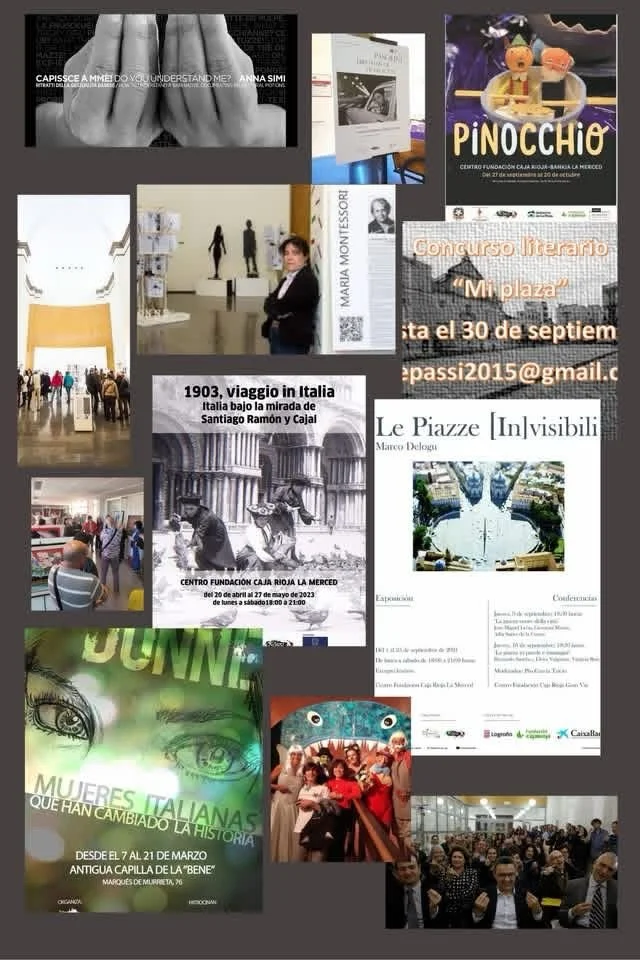
This is precisely why, years ago, I founded the Italian association, "Due passi," to build community. We Italians tend to integrate well into society and therefore often go unnoticed, but the need to belong to a community still remains. Things used to be different; an Italian who migrated to Germany or Switzerland, would save enough money to build a small house in Italy and, once retired, return home. Now the mentality has changed, after spending a lifetime in another country, we belong there. I, for example, have built my life here. Even though I love Italy dearly, and in fact I always say that my blood is green, white and red, like our flag, I don't feel the need to go back and live there. When I return for holidays, I see that everyone has lived their own life and built their own family, each of us has followed a different path. After just a few days, after you’ve met up with friends and family, you realize you no longer have very much in common...
Because you are no longer the same person you were when you left.
We become citizens of the world, because we no longer belong anywhere 100%; in Italy I am “the Spanish”, and here in Spain I'm “the Italian”. But that too, has its charm.
I would like to dwell for a moment on the factors that influence the integration of immigrants; for example, how do cultural associations support newcomers and contribute to an intercultural dialogue between Italy and Spain?
It depends a lot on the associations.Years ago, there weren't many Italian associations, but recently, regional associations have flourished: in Madrid, there are associations from nearly every area of the country. It bothers me a little: these choices are often tied to very specific reasons, such as the subsidies that certain local administrations allocate to regional associations. I, on the other hand, believe in a united Italy, where everyone's origins shouldn't matter. My association is inclusive, open not only to Italians born in Italy, but also to those from all over the world. It's a cultural association, and my goal isn't to spread Italian culture in an overbearing way, but rather introduce it into Spanish culture. For me, this aspect is fundamental.
Because that's how it contributes to an intercultural dialogue, otherwise an island is created.
Yes, and I'm always looking for common ground, not for who is better between Italians and Spaniards. In fact, I believe deeply in cultural twinning because it highlights what we have in common, not what sets us apart. We share many aspects of our history, and Spanish culture has left deep traces in Italy. For example, my dialect is full of Spanish words, like the word sarmiento which in my dialect becomes sarmint, and there are many others. Or the fact that in Sardinia, in the Alghero area, Catalan is still spoken. In my work as an Italian teacher, I often share these examples with my students. There is also the famous Spanish sponge cake, which in Italian is called Pan di Spagna.
I had never thought of that!
There are several theories, one says thatthe Spanish troops brought with them a tasty, light bread that never went stale. Whatever is the true origin, or the legend behind it, it is still associated with Spain and that's how we remember it. Italy and Spain have much more in common than what divides them, and I am always looking for these affinities.
I prefer this approach, in which, comparing two cultures, we start from what they have in common. Because by recognizing similarities, we come together, our defenses are lowered, and a foundation of trust is created. From there it's easier to talk about the differences and what separates us...
Let's talk now about the Italians in Pamplona: what do they do and what are their needs?
The situation in Pamplona is quite complex. I am an honorary member of the “Italiruña” association. I'd love to do more with them, but a lot also depends on institutional collaboration. For example, when I need to request a venue for an exhibition in Pamplona, they are often willing to help, but it's not always easy: if an initiative doesn't have a direct connection to the Navarra region, it becomes more difficult to carry out, and this represents a limitation. However, we have organized some activities, always in collaboration with local associations. For example, years ago we participated in the Pamplona Negra festival, bringing Italian writers to the event. It was still the Covid period, but we still managed to organize it, involving the Italian Cultural Institute and holding exhibitions in various centers, always networking with local organizations: doing it alone is complicated. Running an association requires time and energy, not only for cultural activities but also for all the bureaucratic work involved. I have the advantage of having grown children and can dedicate a lot of time to the Consulate and the association, but that is not the norm. Furthermore, without getting too political, it must be said that some administrations are more open and collaborative than others, while in some cases a more closed-minded or local perspective prevails. Despite everything, however, Italy is slowly making headway.
Which Italian traditions or values, perhaps Apulian ones, that you grew up with, do you still feel are present in your daily life?
All of them. I live here as if I were still in Italy, in my house we listen to RAI or, for example, I serve on a literary jury for publishing houses in Puglia. Also, when we organize cooking classes through the association, we often prepare Puglian dishes.
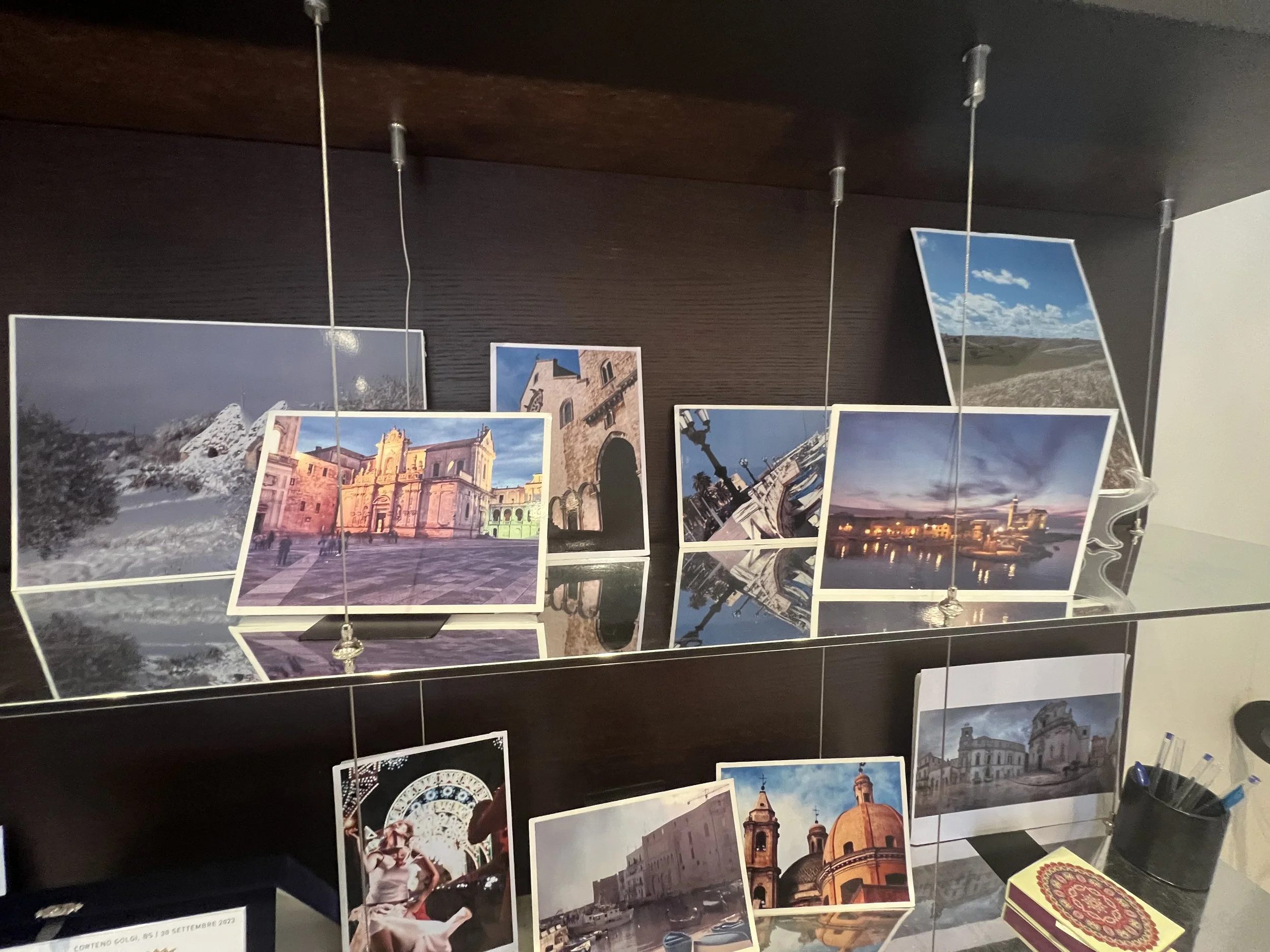
I owe a lot to Puglia, also because it was thanks to an exhibition about the region in 2014 that the history of our association began. I had written to all the Italian regions and local governments because I wanted to organize an exhibition about an unknown, undiscovered part of Italy. The only region that responded was Puglia, which at the time was just beginning to recognize the potential of tourism. Browsing the internet, I found photographs, searched for their authors, and contacted them. Many sent me their own pictures of unknown landscapes. I remember that, at the time, the first drone photos were just beginning to appear, and some of them were beautiful. Puglia then sent me maps and promotional material, and a huge number of people attended the exhibition. Many Italians approached me afterwards, and we started by organizing a few aperitifs, until we eventually came up with the idea of creating an Italian cultural association withcharitable aims. In the first year we started with Tombola (Italian Bingo), then a Befana celebration for children living in a shelter. Since then, every year my office has transformed into the “Befana House” for Spanish and Italian children.
When the new ambassador arrived, we introduced ourselves as an association, and he became interested in visiting the Rioja region. With very little notice, and with the help of members and collaborators, we organized an exhibition about the women who had made history in Italy. While preparing the exhibition, I discovered that a niece of Maria Montessori had lived in a small village in La Rioja. After meeting her nephew, I was able to collect some anecdotes that further enriched the presentation. Sometimes these discoveries happen by chance, and it's wonderful to see these connections between Italy and Spain emerge.
In your opinion, what could be done to create a more effective network between the Consulate, local Italian cultural associations, and local organizations? Also, how could a greater number of Italians be involved? I have the impression that many of these activities and initiatives still don't reach everyone.
The Italian government established the Comites, which in theory should be bodies elected by Italians abroad to represent the entire community. I, as consul, represent the administration; the Comites, on the other hand, are supposed to represent the Italians. The problem is that these Comites are located in Madrid. Everything is centralized, and those of us who live in the peripheral areas of Spain receive little information and are cut off from most cultural initiatives. I've spoken about this many times, both with them and with the first ambassador, the one who appointed me consul. I've complained a lot because we're treated like second-class Italians, when in fact we are fully fledged Italians. I always try to share information, I've joined various Facebook groups, I've established contacts with other associations, and sometimes we collaborate. But, unfortunately, the information network is limited. For example, Italians often need support in managing various procedures, such as pensions, certificates, and other administrative matters. In Madrid, there are patronati that perform this function, whereas in our area there are none. So some time ago, I asked someone I work with to hold a meeting with the Italian community to explain the issue of pensions, INPS, and so on. He agreed, and an association from San Sebastian also participated via livestream. However, it still remains a limited system, because those without access to social media risk being completely excluded.
There needs to be greater support for these initiatives.
For me, the ideal solution would be to create a network among associations, but one that differs from the current Comites system, which mainly focuses on Madrid, Barcelona, and the Canary Islands. They primarily represent Italians living in large cities and lack a widespread presence throughout the country. Therefore, I believe the only possible path is concrete collaboration between the Italian associations in our area, so that each can help disseminate information to its members.
You hold two distinct roles: you lead the "Due Passi" association in Logroño and you also serve as Honorary Consul in Pamplona. Do these two roles ever overlap or conflict in some way?
Sometimes, informally, people comment on things that it would be better if I didn't hear... for example, that they haven't registered with AIRE (Registry of Italians citizens living abroad). So I remind them that I am a public official and it is better not to speak in my presence about irregularities that I obviously could not ignore.
That said, one of the reasons I accepted the position of Honorary Consul was because it opened more doors for me. Applying for something as president of an association is one thing, but in my institutional role, I receive greater collaboration from various administrations. Furthermore, through the Consulate, I also gain access to opportunities that allow me to offer more cultural initiatives. For example, on April 29th, two documentaries produced by the Sardinian association Cittadini del Mondo, "Dall'Est con amore" and "Donne in avanti," were screened at the Casa de las Mujeres in Pamplona. These documentaries focus on female immigration, and the reason they were able to be screened was precisely because they contacted me through the Consulate.
What was the most significant moment in your journey as Honorary Consul?
There are many. I had never even remotely thought that one day I would be able to hold this role. One of the most emotional moments was the swearing-in ceremony. The ambassador was present, and my husband accompanied me. Seeing my family's joy as I took the oath was truly a beautiful moment. When the ambassador's proposal arrived, Ireflected carefully because, along with the honors, there are also responsibilities and burdens. I had doubts, but my family did not. I told them there would be expenses and that I didn't want to take anything away from them, but my husband replied that this role had been made for me; it was what I had always done, except that now I would have official recognition, even if not financial recognition.
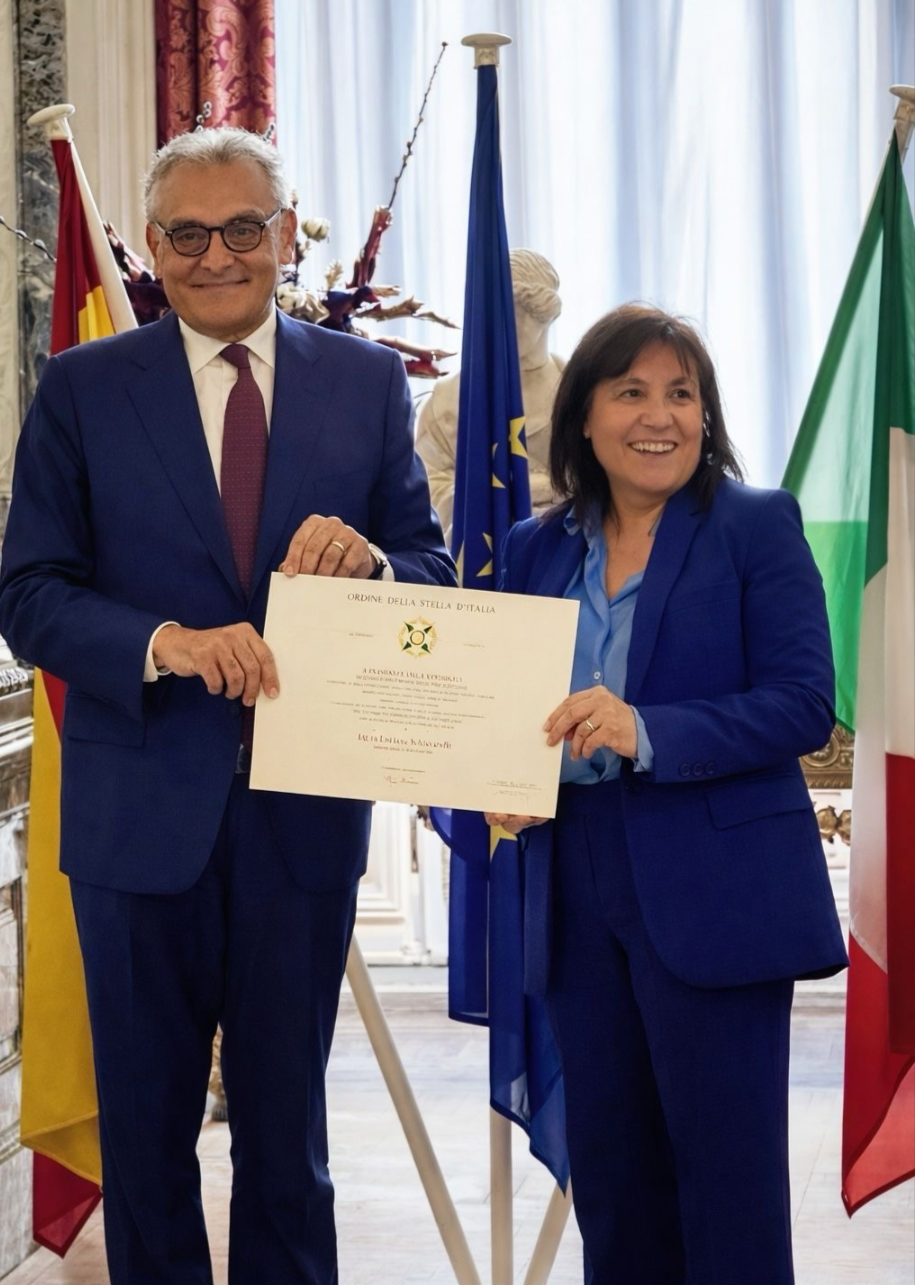
Another significant moment was when a middle school teacher of mine, who also happened to be the director of the theater company with which I toured part of Europe, wrote a beautiful article about me, published in Italy. It recounted my journey in Spain leading up to receiving the honor of “Knight of the Order of the Star of Italy”, awarded to me by the Ambassador for my work promoting Italian culture, and above all because I had always done it out of passion, without expecting anything in return. Then came other unexpected recognitions, which surprised me greatly: the “Cavaliere” and then the “Ufficiale”. I was happy, but not for myself, but rather for all those who believed in me, like my family and my professor. Seeing the pride in the eyes of those dear to me is what makes me happiest. I do what I do out of love for my country. Having that recognized, is something extra.
But it's beautiful, because it gives a sense of everything that has been accomplished.
Yes, although I believe that when you love something and are capable of doing it, you simply have to do it. If you can help someone, you should to do it. That is the educationI received and it is the reason why I move forward every day, with emotion and enthusiasm.